

By XMRWallet Team · Published · 7 min read · ← Part 1: Charitable Projects and Transparent Giving
Part 1 of this series examined how blockchain infrastructure has created a new foundation for transparent, accountable charitable giving, and introduced the organizations that pioneered crypto philanthropy. This second part moves from infrastructure to outcomes — examining how digital assets performed in real humanitarian crises, what limitations emerged, and why Monero's privacy properties give it a distinctive role in certain giving scenarios.
COVID-19: A Stress Test for Crypto Relief
When India experienced a devastating second wave of COVID-19 in spring 2021, healthcare systems were overwhelmed, oxygen supplies ran critically short, and hospital capacity collapsed across major cities. The scale of need triggered a global response — and one of its most significant contributions came through cryptocurrency.
Vitalik Buterin, co-founder of the Ethereum blockchain, made what remains one of the largest single crypto charity transfers on record. He donated 50 trillion Shiba Inu (SHIB) tokens — valued at approximately $1.2 billion at the time — to CryptoRelief, an India-focused fund coordinated by Polygon co-founder Sandeep Nailwal. The donation required careful management: selling such a large SHIB position too quickly would have collapsed the token's market price, so the team worked to convert the funds gradually and responsibly. By mid-2021, $20 million had already been distributed for oxygen concentrators, ICU equipment, and related relief supplies.
CryptoRelief subsequently returned $100 million in USDC to Buterin, citing complications navigating the Indian government's uncertain posture toward cryptocurrency. Nailwal explained that deploying funds through a non-Indian entity — in this case Buterin himself — would enable faster allocation to higher-risk, higher-impact medical research projects globally. Buterin confirmed his intention to continue that work in coordination with CryptoRelief's existing programs.
In a separately notable gesture, Twitter co-founder Jack Dorsey converted the proceeds from the auction of his first-ever tweet — roughly $2.9 million, converted to approximately 50 BTC — and donated the full amount to GiveDirectly's Africa COVID-19 relief program, which provided direct cash transfers to households facing economic hardship as a result of the pandemic.
The Freedom Convoy: What Freezing Crypto Taught the World
In early 2022, Canadian truckers organized the Freedom Convoy protest in Ottawa. When the GoFundMe campaign for the convoy was frozen and refunded, many supporters shifted to cryptocurrency as an alternative channel — raising nearly $1 million in Bitcoin, Litecoin, Ether, Ethereum Classic, Cardano, and Monero.
The Canadian government's subsequent invocation of the Emergencies Act allowed authorities to compel centralized cryptocurrency exchanges to freeze assets linked to the convoy. Funds held in Bitcoin and other transparent-chain assets were identified and frozen through a Mareva injunction by compelling exchanges to cross-reference customer KYC data with known wallet addresses.
Monero (XMR) donations to the convoy occupied a fundamentally different position. Because Monero's ring signatures, stealth addresses, and RingCT make it cryptographically infeasible to link on-chain activity to specific wallet addresses or identities, it is highly improbable that XMR contributions were traced back to individual donors or frozen by authorities. This episode demonstrated in real-world conditions a key distinction between transparent-chain donations and privacy-coin donations — a distinction that carries practical significance for donors in politically sensitive contexts.
Ukraine: The First Government to Solicit XMR Donations
When Russia invaded Ukraine in February 2022, the Ukrainian government turned to cryptocurrency with unusual speed and sophistication. Official wallet addresses for Bitcoin, Ethereum, Polkadot, USDT, and Dogecoin were published directly on the government's Twitter account within days of the invasion — one of the first instances of a national government formally soliciting crypto donations at scale.
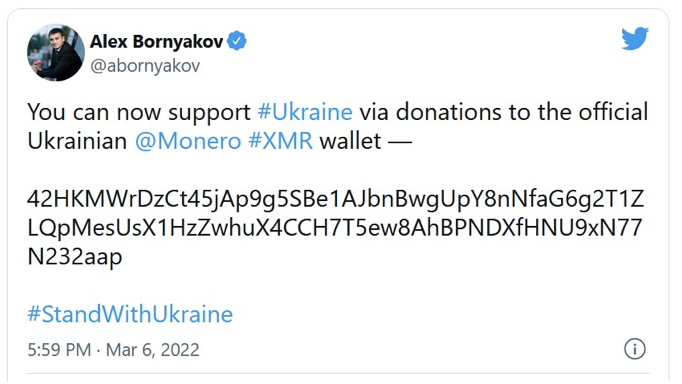
What distinguished Ukraine's campaign further was the explicit inclusion of Monero. Alex Bornyakov, Deputy Minister of Digital Transformation for IT Development, confirmed that XMR donations were accepted, recognizing that some international donors would prefer to contribute without creating a publicly traceable on-chain record. According to blockchain analytics from Elliptic and others, total crypto donations to Ukrainian government wallets and affiliated charities exceeded $200 million within the first year — funding purchases of military supplies, medical equipment, and humanitarian aid.
What These Cases Reveal About Crypto Philanthropy
These episodes collectively illuminate both the strengths and the real constraints of cryptocurrency in humanitarian contexts. On the positive side: crypto moved across borders instantly, without correspondent banking relationships or wire transfer delays; it was received directly by organizations without requiring a payment processor's approval; and blockchain's public record allowed donors to verify that funds had arrived.
The constraints were equally visible. Converting large positions — as CryptoRelief discovered with the Shiba Inu donation — requires careful market management to avoid price impact. Regulatory uncertainty, particularly in countries with ambivalent or hostile stances toward crypto, can complicate fund deployment even when the humanitarian intent is unambiguous. And for transparent-chain assets, the same public ledger that enables accountability also enables targeted freezing by authorities.
Monero addresses the last of these constraints directly. Its privacy protections are not a workaround or an add-on — they are built into the protocol at a fundamental level. For donors who operate in politically sensitive environments, or who simply believe that financial privacy is a legitimate right, XMR provides a mechanism for giving that no authority can easily monitor or block.
Give Securely With XMRWallet
Whether you are donating to organizations that accept Monero directly — including the Electronic Frontier Foundation, The Tor Project, or international humanitarian groups — XMRWallet makes the process straightforward. It is free, open-source, browser-based, and requires no registration or personal information. You keep full custody of your keys until the moment you choose to send — your donation is private, fungible, and final.
Frequently Asked Questions
Why is Monero useful for humanitarian donations?
Monero's default privacy means donors cannot be identified from blockchain data and amounts are not publicly visible. This is valuable when donors fear government retaliation, social consequences, or censorship — particularly in authoritarian contexts. Unlike Bitcoin, Monero's on-chain activity cannot be frozen by compelling exchanges to block specific addresses, because addresses are not linkable to identities or transactions through public chain analysis.
Can cryptocurrency donations be frozen by governments?
Transparent-chain crypto donations — Bitcoin, Ethereum — can be frozen when authorities compel centralized exchanges to block wallet addresses or withhold customer funds. This was demonstrated during the 2022 Freedom Convoy in Canada, where Mareva injunctions forced exchanges to freeze identifiable crypto holdings. Monero donations are significantly harder to freeze because ring signatures and stealth addresses prevent authorities from linking on-chain activity to specific individuals.
How much crypto was donated to Ukraine?
Blockchain analytics firms including Elliptic tracked crypto donations to Ukrainian government wallets and affiliated charities exceeding $200 million in the first year following the 2022 Russian invasion. Ukraine's government accepted Bitcoin, Ethereum, Polkadot, USDT, Dogecoin, and Monero. It was among the first national governments to formally solicit XMR donations.
- CryptoRelief — India COVID-19 crypto relief fund
- GiveDirectly — Jack Dorsey's Africa COVID-19 relief donation recipient
- Elliptic — Blockchain analytics tracking Ukraine crypto donations
- Electronic Frontier Foundation — Accepts Monero (XMR) donations
- The Tor Project — Accepts Monero donations
- Monero Moneropedia — Technical explanation of privacy features
- XMRWallet on GitHub — Open-source non-custodial Monero wallet
