


Monero owners know it is essential to have an XMR wallet to store their keys and coins in. A Monero wallet enables you to secure, manage, send and receive, and mine XMR. When you create an XMR wallet, one of the first things you look for is your public address. A public address or a public key is an alphanumeric string of code that enables users to receive XMR. Unlike a private key, you can share your public key freely with anyone. Monero wallets, like XMRWallet, have subaddresses aside from a public address.
What is a Monero subaddress?
Subaddress is Monero’s solution to maintain the anonymity of the recipient against the possibility of a payer linking your payouts and deanonymize you. It is a simpler way to receive XMR and more user-friendly than using addresses from different wallets. This is especially helpful if you need to post a public address widely in order to receive donations, for example. You can generate a huge number of subaddresses under the main address and all the funds will go to one wallet.
How are subaddresses created?
Each XMR wallet has two pairs of keys. The private view and spend key, which, as the name implies, must be kept to oneself. It also has a public view and spend key, which are encoded into the wallet address. Subaddresses are generated from a series of mathematical equations and encoded into the public address. These computations allow for non-linkable transactions to go to the same wallet.
Is subaddress the same as integrated address?
An integrated address is a replacement for payment IDs that merchants require in order to identify who sent how much and for what. The cryptographic technologies inherent in the Monero blockchain make it nearly impossible for merchants to distinguish and sort transactions. An integrated address merged the address and payment ID in one string and enabled merchants to identify transactions properly. It was not adopted widely by merchants, though, and subaddresses became a preferred way to do away with payment IDs. The ability to generate multiple addresses for one main address and identify transactions associated with each subaddress allowed merchants to get rid of payment IDs.
Which one gives the best protection?
Monero holders who want the strongest measure of privacy and control should use independent wallets or seeds for each activity they want to be isolated from others. One wallet may be for XMR earned from work, another for purchases, and another for donations. For most people, though, this may be highly impractical and inefficient. For shopkeepers and those who receive XMR via frequent transactions, integrated addresses may serve their needs, but these may allow passive observers and counterparties to connect related addresses together, especially if the addresses are posted publicly. Subaddresses provide a happy medium. They offer stronger protection than integrated addresses and are more user-friendly than dealing with several independent seeds, but may be susceptible to weaker protection against some attacks, like the “Janus attack.”
How can I get a subaddress?
Most reputable XMR wallets have features that allow you to generate subaddresses on a single account or provide subaddresses you can use to receive XMR.
For XMRWallet
1. You will find “View subaddresses” once you log in and the Overview page comes up.
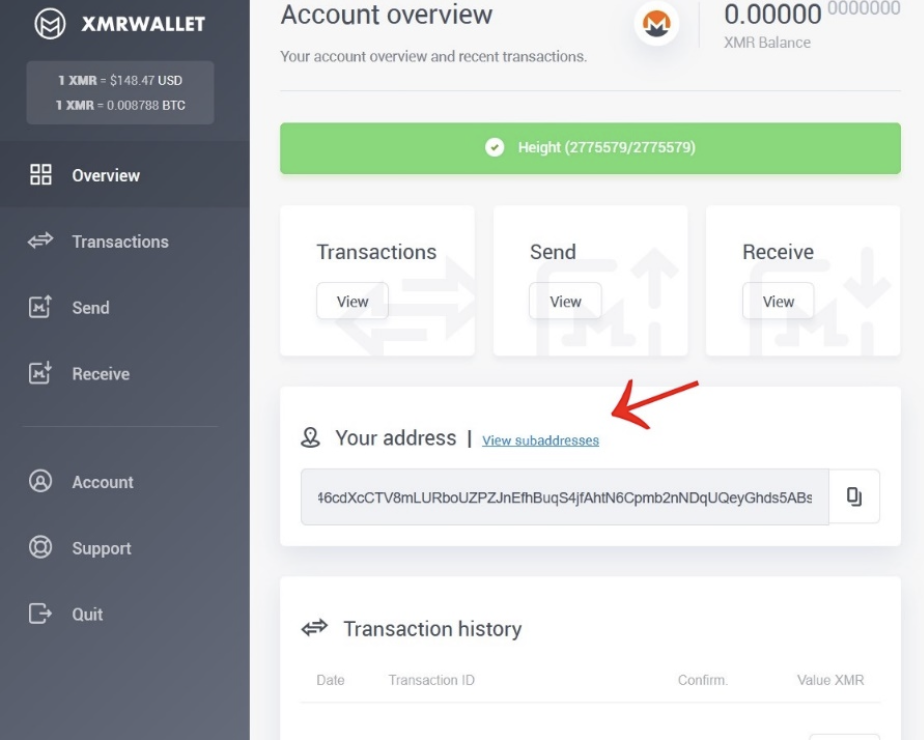
2. Click and the subaddresses will appear.

3. You can also find it on the “Send” page.
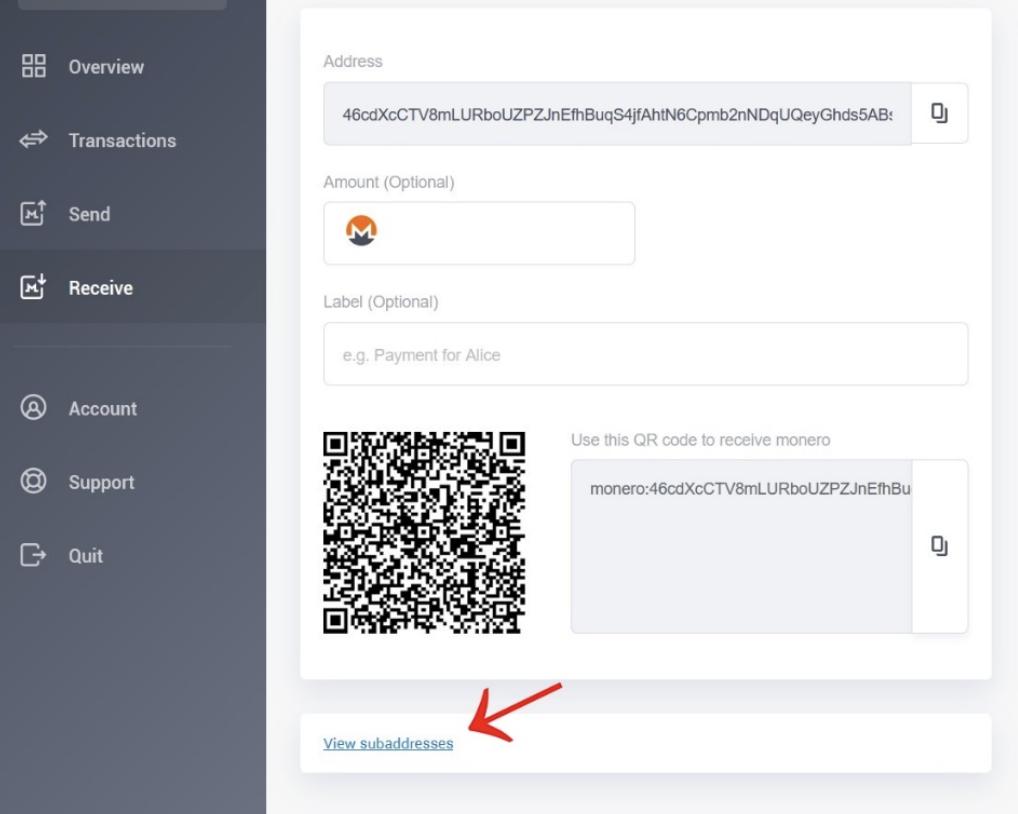
4. Click on it and the subaddresses will appear.
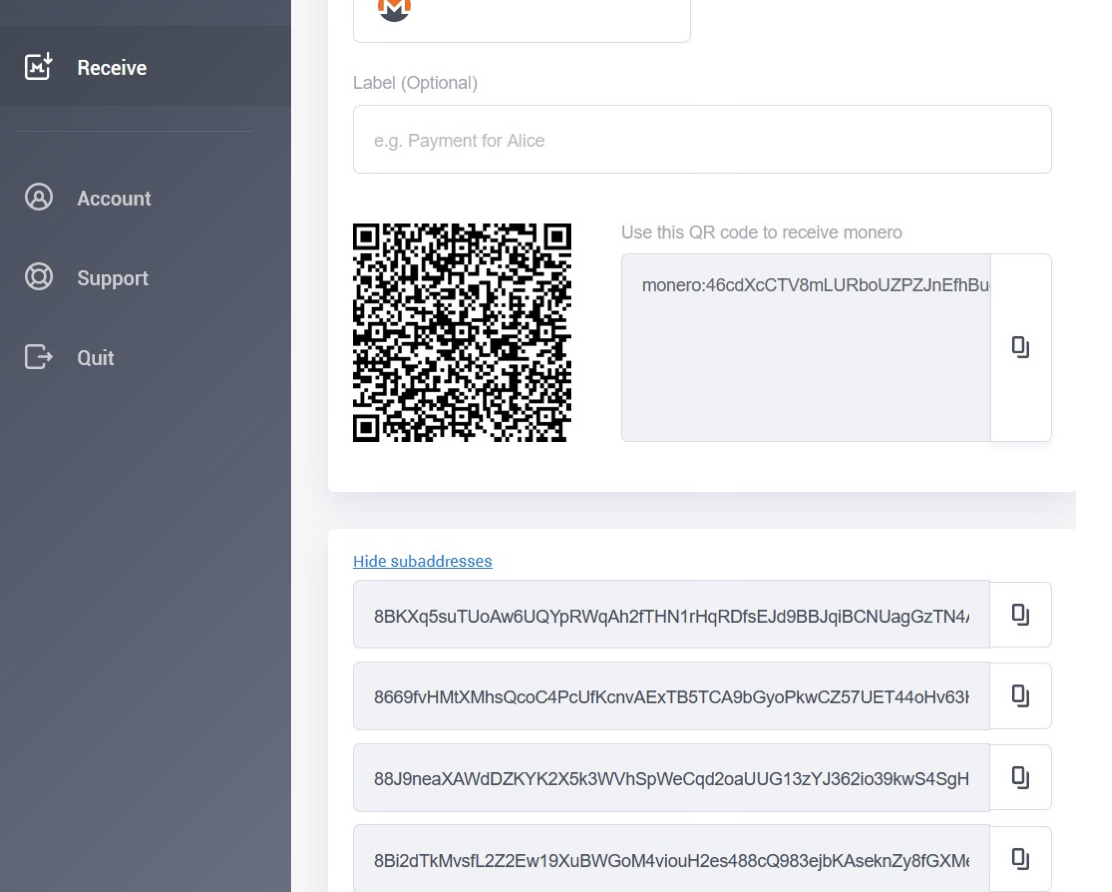
There are some websites that allow you to generate a subaddress. Avoid these sites as they will require you to enter your 13, 24, or 25-word mnemonic speed. You may lose all your XMR by providing your seed to an unknown entity online.
Get into the habit of providing a subaddress, instead of the public address provided by your XMR wallet, especially to people or organizations you do not know or are not sure of. It is a simple tool that makes your transactions non-linkable and keeps your anonymity. Users who prioritize privacy over convenience, however, may find that using separate seeds for different purposes to be more prudent. XMRWallet is a free lightweight Monero wallet that provides you with subaddresses. It also allows you to create as many wallets as you need if you prefer the highest level of privacy.
